
41 of the 47 air frost days a year recorded at the Met Office Wellesbourne station in Warwickshire fall between November and March. Rainfall, by contrast, varies far less through the year. So the best time to start an extension in Rugby has less to do with avoiding rain and more to do with keeping frost away from new brickwork, and with having every approval in place before the first spade goes in. This guide sets out the weather record, the stages that are weather sensitive, the published approval times and a way to work back from your preferred start.
The short answer
Spring and summer starts carry the least frost risk
For a Rugby extension, spring and summer starts carry the least frost risk: Warwickshire averages almost no air frost from June to September. Rain falls in every season, so it decides less. The bigger factor is preparation. Planning, building regulations drawings, party wall notices and the contract should be settled before the start date, which usually means starting that work in the autumn or winter before.
1. What does the Warwickshire weather record actually show?
At the Met Office Wellesbourne station, 41 of the 47 average yearly air frost days fall between November and March, while monthly rainfall only moves between about 40 and 63 millimetres.
The Met Office publishes 30-year averages for its Wellesbourne station in Warwickshire. For 1991 to 2020 it records an average of 47.3 days of air frost a year. December has about 10, January about 10, February about 9, March about 7 and November about 5. June has almost none, and July to September have none at all. Rugby is not Wellesbourne, so treat these as a county guide rather than a forecast for your street.
Rain is a different story. The wettest month on the same record is October at about 63 millimetres and the driest are February and March at about 40. Days with at least a millimetre of rain range from about 8.5 in July to about 12 in November. Summer has slightly fewer rain days, but not less rain overall. What really changes through the year is frost and sunshine: average sunshine is about 54 hours in December and about 200 hours in July.
| Months | Air frost days | Rainfall | Sunshine |
|---|---|---|---|
| December to February | About 9 to 10 a month | 40 to 56 mm a month | 54 to 79 hours a month |
| March to May | About 7, then 4, then 1 | 40 to 55 mm a month | 116 to 196 hours a month |
| June to August | Almost none | 52 to 60 mm a month | 181 to 200 hours a month |
| September to November | None, then 1, then 5 | 51 to 63 mm a month | 66 to 143 hours a month |
Where the quick answers go wrong
A June 2023 MyJobQuote post says March to June are among the driest months, credited to the Met Office without a link. On the Wellesbourne record March is dry, but May and June are wetter than February. A May 2026 MyJobQuote question drew ten trade answers ranging from any time, to May to August, to August to October, with no data behind any of them. A March 2026 Less post says booking off-season can save 10% to 20%, but gives no source, so we have not used that figure.
Check the guidance: Met Office: Wellesbourne climate averages, MyJobQuote: reasons to start an extension in summer, MyJobQuote: when is the best time to build an extension?, Less: best time to get home improvements done.
2. Which stages of an extension depend on the weather?
LABC treats 2°C as the minimum working temperature for most materials, so frost matters most while the foundations, walls and roof are open to the air.
An extension is weather sensitive in its first half and much less so once it is weathertight. Digging and pouring foundations, laying bricks and blocks, and getting the roof covered all happen outside. After the roof is on and the openings are closed, most of the remaining work happens indoors: first fix services, plastering, screeding, second fix and decorating.
Building control guidance from LABC, dated February 2021, says two degrees is the minimum working temperature for most materials. New masonry needs frost protection when temperatures drop below 2°C, render should only go on at 2°C and rising, and plastering and screeding should not go ahead unless the building is free from frost. It also says frozen materials should not be used at all, and that bricks, blocks, sand and cement should be kept covered.
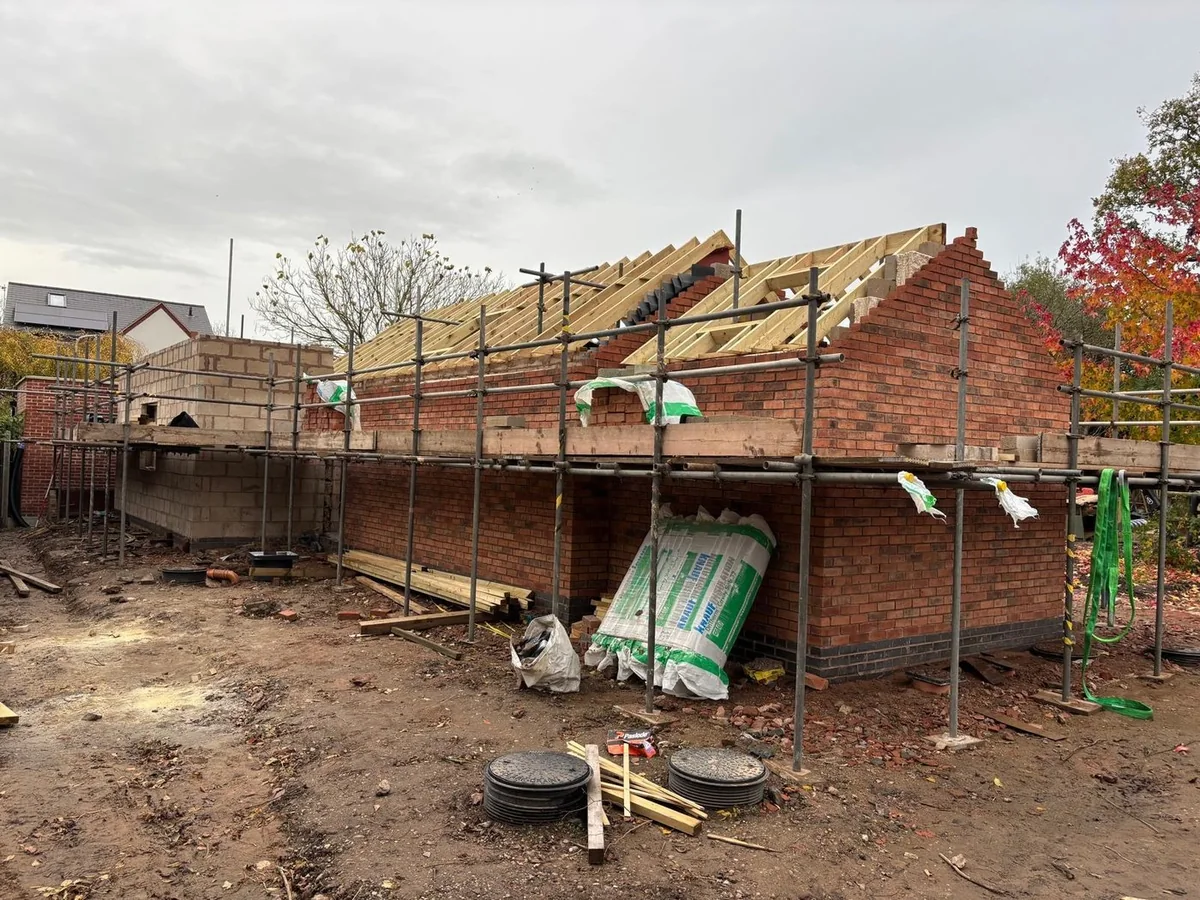
Rain matters too, but in a different way. A wet spell slows digging and brickwork and can leave a site muddy, as the lead photograph shows. The averages above suggest that in Warwickshire rain arrives in every season, so a programme should allow for wet days whatever month it starts.
What a winter start needs on site
A start between November and February is not ruled out, but it needs more planning. Ask your builder how materials will be stored and covered, how new brickwork will be protected overnight, who will check temperatures and what happens to the programme on frost days. Once the shell is closed, ask how the inside will be kept frost free while plaster and screed dry. The answers should be written into the programme, not left to the day.
Check the guidance: LABC: working in cold weather.
3. How long does the paperwork take before work starts in Rugby?
Most planning applications are decided within 8 weeks, a full plans building regulations decision takes up to 5 weeks or 2 months, and party wall notice must be served at least 2 months ahead.
Weather decides how easily the build runs. The paperwork decides when it can start. GOV.UK says most planning applications are decided within 8 weeks, and that unusually large or complex applications in England have 13 weeks. Rugby Borough Council says permitted development rights can be adapted or removed, and can differ for listed buildings and conservation areas. The council lists 19 conservation areas in the borough, where it has extra powers, and charges a fee for pre-application advice.
If your extension falls within permitted development, the Planning Portal limits for a single-storey rear extension include a depth of 4 metres beyond the original rear wall for a detached house and 3 metres for other houses, a height of 4 metres, and eaves of no more than 3 metres within 2 metres of a boundary. Outside designated land, larger rear extensions of up to 8 metres for a detached house or 6 metres for others need a prior approval application. A lawful development certificate is optional, but it confirms the position in writing, and the council has eight weeks to decide.
Building regulations are a separate approval. GOV.UK says a full plans application should be decided within 5 weeks, or 2 months if you agree. With a building notice, work can start 2 days after the notice is submitted, but there is no formal approval of plans. In Rugby, building control is run by Warwick Building Control, a partnership between Rugby Borough Council and Warwick District Council. Party wall duties are separate again: notice must be given between 2 months and a year before work starts.
| Step | Published period | Source |
|---|---|---|
| Householder planning application | Most decided within 8 weeks | GOV.UK |
| Lawful development certificate | Eight-week decision limit | Planning Portal |
| Building regulations full plans | 5 weeks, or 2 months with consent | GOV.UK |
| Building notice | Work can start 2 days after submission | GOV.UK |
| Party wall notice | 2 months to a year before work | GOV.UK |
| Neighbour consent to a party wall notice | In writing within 14 days | GOV.UK |
Check the guidance: GOV.UK: planning permission, Rugby Borough Council: Do I need planning permission?, Rugby Borough Council: conservation areas, Planning Portal: extension planning permission, Planning Portal: lawful development certificates, GOV.UK: how to apply for building regulations approval, Rugby Borough Council: Warwick Building Control, GOV.UK: party walls and building work.
4. Working back from the start date you want
For a spring start, the design, approvals and builder selection usually need to be under way in the autumn or winter before.
The Federation of Master Builders (FMB) guide to extensions says a straightforward single-storey extension may take around three to six months to build. Before that, it lists surveys and design, planning or prior approval, building regulations drawings, structural calculations, party wall notices, choosing a contractor, ordering long lead products and the builder's existing commitments. Older FMB guidance, dated January 2019, said homeowners should expect to wait at least four months for a quality builder to be available.
Put those together and work backwards. Suppose you want a builder on site in April. Party wall notice has to be served by early February at the latest. If planning permission is needed, an application validated in early December could be decided in early February, assuming no extension of time. That leaves design and drawings to be finished in November. This is our arithmetic on the published periods, not a promise about any council, builder or project.
If the design is not ready, choosing a start month will not help much. The month you start matters less than whether the approvals, drawings and contract are settled before the first day on site.
If you are aiming for a summer start
Summer has the most sunshine and, on the Wellesbourne record, no air frost from July to September. The trade answers we opened describe summer as popular, though none gives evidence. If you want to start in June or July, the same backwards sum points to drawings in late winter, any planning application by early spring and party wall notice served by April or May.
Check the guidance: FMB: house extensions, the ultimate guide, FMB: how far ahead to plan home improvements.
5. Season by season: what each start gives you
Each start season has a trade off between site conditions, finish date and the time left to prepare, so pick the one that suits your household and your paperwork.
A Wickes trade page, undated, says larger extensions usually start in spring because the ground is soft enough to dig. That fits the frost record, but it is a retailer's view, not a rule. The table sets out the trade offs using the sources above, rather than a ranking.
| Start | Site conditions | What to plan for |
|---|---|---|
| March to May | Frost becoming rare, light increasing | Approvals and contract settled over winter |
| June to August | No air frost, most sunshine | Approvals settled by spring; garden out of use in summer |
| September to October | Frost returns from October; wettest month on record | Shell finished before the frosty months |
| November to February | Most frost days and least light | Material protection and a frost-free inside for plaster |
Why autumn starts need a closed shell
An autumn start gives most of the outdoor work a frost-free window if it moves quickly, but the record shows frost building again from November. Ask when the roof should be covered and the openings closed, and what happens if that date slips into December.
Check the guidance: Wickes: top spring jobs for trades, Met Office: Wellesbourne climate averages, LABC: working in cold weather.
6. Nesting birds, VAT and household timing
All wild birds are protected under the Wildlife and Countryside Act 1981, so clearing a nest that is in use or being built is an offence whatever the build programme says.
GOV.UK planning guidance, updated April 2025, says it is an offence to take, damage or destroy a nest that is in use or being built. It suggests avoiding harm by doing work at a different time of year or removing habitat features before the nesting season. If your extension needs a hedge, shrubs or a tree cleared, or roofing work near existing eaves, ask early whether that clearance should happen before the season starts.
Timing does not change the VAT rate. GOV.UK says most building work on existing houses is standard rated at 20%, with certain exceptions. When you compare quotations, check whether each figure includes VAT, whatever month the work is planned for.
Then there is your own calendar. An extension at the back of the house often means losing part of the garden and sometimes the kitchen for a period. Think about school holidays, family events and Christmas, and ask your builder how the programme treats the weeks when the inside of the house is affected.
Check the guidance: GOV.UK: wild birds advice for planning decisions, GOV.UK: VAT for builders.
7. What to bring to the first conversation
A builder can only talk usefully about a start date once they know the design stage, the approvals you need and any boundary issues.
Bring your Rugby postcode, photographs of the rear of the house and the garden, any drawings, and whether you think the work is permitted development or needs a planning application. Say whether a neighbour's wall or foundations are within reach of the work, since that brings party wall notice into the plan, and whether the house is in a conservation area. Tell the builder the season you would prefer and why. A good answer will explain what needs to happen first and when, rather than simply naming a date.
Check the guidance: Rugby Borough Council: conservation areas, GOV.UK: party walls and building work.
What clients say
Recent words from Belmax clients.
Three public five-star review excerpts, checked 24 September 2026.
“We have been really happy with the service from Belmax Builders. They are reliable, professional and, most importantly, always kept to the agreed schedule.”
“Belmax did the job to very high standard, communicated with us the whole time and explained really well what to expect.”
“Job was started on time and Rob kept us up to date every step of the way. The finished conversion looks amazing.”
Frequently asked questions
What is the best month to start an extension in Rugby?
No single month is best for every Rugby home. The Met Office Wellesbourne record shows almost no air frost from June to September and most frost from November to March, so spring and summer starts carry less frost risk. Rainfall is spread through the year. The bigger factor is usually whether planning, building regulations drawings, party wall notices and the contract are settled before the start date.
Can you build an extension in winter?
Yes, with more protection. LABC guidance says two degrees is the minimum working temperature for most materials, new masonry needs frost protection below 2°C, and plastering and screeding should only happen in a frost-free building. Ask your builder how materials will be covered, how new brickwork will be protected and how frost days will be handled in the programme before you agree a winter start.
How far ahead should I plan an extension?
Work backwards from your start date. Most planning applications are decided within 8 weeks, a full plans building regulations decision takes up to 5 weeks or 2 months with consent, and party wall notice must be served at least 2 months before work. Design, surveys and choosing a builder come before those. Older FMB guidance from 2019 suggested waiting at least four months for a quality builder.
Is it cheaper to build an extension in winter?
We found no reliable source showing that. One March 2026 blog says booking off-season can save 10% to 20%, but it gives no evidence or method, so treat it with caution. VAT is the same whatever the month: most work on existing houses is standard rated at 20%. Compare written quotations on the same scope, and check whether each one includes VAT and protection costs.
Do nesting birds affect when I can start?
They can. GOV.UK guidance says all wild birds are protected under the Wildlife and Countryside Act 1981, and it is an offence to take, damage or destroy a nest that is in use or being built. If your project needs hedges, shrubs or trees cleared, plan that work before the nesting season, and check with your builder before roofing work near existing eaves.
Sources
Figures, fees and rules change. Every source below was checked on 2 November 2026.
- Met Office: Wellesbourne climate averagesWellesbourne station, Warwickshire, 1991 to 2020 monthly averages for frost, rain and sunshine. Opened 2 November 2026.
- LABC: working in cold weatherArticle dated 9 February 2021 on frost protection for masonry, render and plaster. Opened 2 November 2026.
- GOV.UK: planning permissionMost applications decided within 8 weeks; 13 weeks for unusually large or complex ones. Opened 2 November 2026.
- Planning Portal: extension planning permissionPermitted development limits and prior approval for larger rear extensions. Opened 2 November 2026.
- Planning Portal: lawful development certificatesOptional certificate with an eight-week decision limit. Opened 2 November 2026.
- GOV.UK: how to apply for building regulations approvalFull plans decision within 5 weeks, or 2 months with consent; building notice start after 2 days. Opened 2 November 2026.
- GOV.UK: party walls and building workNotice between 2 months and a year before work; 14 days to consent in writing. Opened 2 November 2026.
- GOV.UK: wild birds advice for planning decisionsUpdated 7 April 2025. Nests in use or being built are protected by the Wildlife and Countryside Act 1981. Opened 2 November 2026.
- GOV.UK: VAT for buildersMost work on existing houses is standard rated at 20%, with listed exceptions. Opened 2 November 2026.
- FMB: house extensions, the ultimate guideUndated guide; three to six months to build a straightforward single-storey extension. Opened 2 November 2026.
- FMB: how far ahead to plan home improvementsDated 25 January 2019; research date and sample not stated. Opened 2 November 2026.
- Rugby Borough Council: Do I need planning permission?Permitted development rights can be adapted or removed; pre-application advice is charged. Opened 2 November 2026.
- Rugby Borough Council: conservation areasRugby currently has 19 conservation areas with extra council powers. Opened 2 November 2026.
- Rugby Borough Council: Warwick Building ControlBuilding control for Rugby is run by a partnership with Warwick District Council. Opened 2 November 2026.
- MyJobQuote: when is the best time to build an extension?Trade answers dated 29 to 31 May 2026. Quoted only to show what readers are told. Opened 2 November 2026.
- MyJobQuote: reasons to start an extension in summerLast updated 29 June 2023. Quoted only to show what readers are told. Opened 2 November 2026.
- Wickes: top spring jobs for tradesUndated retailer page. Quoted only to show what readers are told. Opened 2 November 2026.
- Less: best time to get home improvements donePublished 8 March 2026. Its saving figure is unsourced and is not used. Opened 2 November 2026.